When every brand starts to look the same
Being seen is no longer enough for a brand. Audiences expect companies that understand their needs, communicate clearly and deliver on their promises. In the B2B world, that audience is often an entire buying committee. Trust has become a strategic asset, and unlike reach, it can’t be bought with a campaign: it builds up through every interaction a person has with a company.
What Is Brand Trust?
It’s the perception that a company will deliver on what it promises. It depends less on what a brand says than on what it does: when the message and the experience don’t match, no campaign can close that gap.
Why It Matters, Especially in B2B
According to the 2026 Edelman Trust Barometer Special Report on brands, 88% of people consider trusting a brand an important or critical purchase criterion, virtually on par with quality (89%) and value (88%).
In B2B, the effect is even greater. Buying decisions take longer, involve several people and carry a professional risk for whoever chooses the vendor: no one wants to be the person who recommended the wrong company. In that context, reputation works like insurance. It lowers perceived risk and shortens the path to a decision.
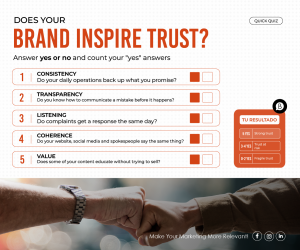
Five Keys to Building Trust
- Consistency between promise and experience. Audiences spot contradictions quickly. Before communicating a brand attribute, ask whether day-to-day operations back it up.
- Transparency, especially when things go wrong. Trust is truly tested in difficult moments: a change, a mistake, a crisis. At those times, silence also sends a message, and it is usually filled with someone else’s version of the story. Humanizing communication doesn’t mean adopting a casual tone; it means speaking plainly and acknowledging what isn’t working.
- Active listening. Monitoring conversations in the media and on social networks helps detect doubts, complaints and opportunities before they escalate.
- Consistency at every touchpoint. The relationship begins long before the sale: with what someone finds on Google, reads on LinkedIn, sees in the media or hears from a colleague. If the website, the sales team, spokespeople and social channels send different messages, perception becomes fragmented.
- Content that adds value. Not everything has to sell. According to the 2024 Edelman-LinkedIn B2B study, nearly three out of four executives trust a company’s thought leadership content more than its marketing materials, and nine out of ten are more receptive to its sales outreach when that content is consistent and high quality.
A Real Case: Rebuilding Trust in the Middle of a Crisis
At Bindiva, we worked with a fintech company facing a reputation crisis on social media. User complaints were piling up unanswered, and with every ignored message, frustration grew. The problem was no longer just the original complaint; it was the brand’s silence.
Together with the company’s communications and marketing teams, we developed an integrated strategy on two fronts. The first was customer care: responding to, routing and following up on every case so people felt heard again. The second was an organic content strategy that showed a clearer, more approachable side of the brand.
These were tense months, and transparency proved decisive. Sharing every step of progress with real data helped the company’s team trust the process, while users began to notice a genuine change.
Within 12 months, brand perception turned around dramatically. Negative comments and spam dropped considerably, especially on Facebook, and the brand reached up to 1.9 million profiles and 38,000 interactions per month. Trust wasn’t restored with a single message, but with consistent responses and the discipline to sustain the effort.
Marketing and PR: Two Halves of the Same Strategy
Marketing knows the business goals, the audiences and campaign performance. Public Relations understands public conversation, the media and reputation. Managed separately, each falls short: a campaign without credibility dilutes its reach, and strong media coverage without a business strategy rarely turns into revenue. At Bindiva, we integrate both disciplines, starting from the business and the people behind it.
How to Measure Trust
Followers, impressions and clicks show reach, not trust. To get closer to measuring it, combine indicators such as media and social sentiment, share of voice against competitors, NPS or perception surveys, repurchase or renewal rates, and how audiences react during a crisis. Data alone doesn’t build trust: what makes the difference is the decisions made with it.
Brands no longer compete only for attention, but for credibility. The question is no longer just how to get noticed, but how to earn trust.
Contact us and discover how an integrated Marketing and Public Relations strategy can strengthen trust in your brand and transform your business. Follow us on LinkedIn, Instagram and Facebook. Visit our blog for more ideas and trends.
Frequently Asked Questions
What is brand trust? It’s the perception that a company keeps its promises, acts consistently and delivers an experience aligned with what it communicates.
How do you build trust with customers? Through consistency, transparency, active listening, a coherent experience at every touchpoint and content that adds value.
Sources:
2026 Edelman Trust Barometer Special Report on Brands: https://www.edelman.com/trust/2026/trust-barometer/special-report-brands
2024 Edelman-LinkedIn B2B Thought Leadership Impact Report: https://www.edelman.com/expertise/Business-Marketing/2024-b2b-thought-leadership-report